GANESHA
AND THE HINDU PANTHEON |
|
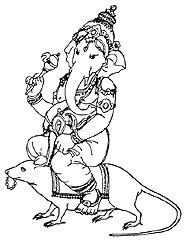
Ganesha is anthropocentric i.e., centering the universe in himself and his idographic image is the image of a cosmic man conceived by man in a grotesque form. This cosmic man has power to project the world and withdraw the same at his will. He is the presiding Deity of the Muladhara depicted as sitting on a mouse which is considered a mystic animal in many countries. In certain depictions the mouse is seen merrily eating the sweet cakes given to its master by his devotees. The selection of this frail and tiny rodent as a mount for Ganesha perforce, is of great significance. The thoracic cavity of the human body contains the fleshy heart and lungs which are controlled by the Medulla oblongata. The lungs occupy a greater part of its space. The lungs besides helping the respiratory process, maintain the flow of the breath of life steady and constant to play the rhythmic tune of life as 'Ham' and 'Sam' just as the bag of bagpipe maintains the supply of air to the reed producing the music steady and constant so that the rhythm and melody of the music does not get intermittant or get snapped in the course of the piper's performance. Thoracic cavity is called moochakam in Dravidian Tamil. Mooch means the breath of life. Akam means a room or closet. Moochakam therefore refers to the room or closet where the breath of life is tuned and conditioned for phenomenal manifestation. If the breath of life snaps or gets severed from its internal mooring, the life will become extinct. If it is controlled or withdrawn from its usual activity, it remains in a state like that of suspended animation as in the case of a foetus floating in a pool of amniotic fluid in its mother's womb, reminiscent of God Narayana floating on the face of waters before creation. |
 This
is idolatery not in keeping with the yoga ideology which Ganesha is supposed
to represent. But the protagonists of idolatery say that the idol worship
is not bad for the reason that the dedicated idol is held to be the abode
of super human personality or the symbol of a great ideal or thought which
makes it different from the statue or a piece of art, or a lump of clay
or stone. This argument though plausible may not be sound as it is made
on the assumption that such idols require worship and this worship is
the sum total of all virtues. It is such arguments that made many Buddhists
to take to the worship of Buddha's idol instead of following the moral
principles laid down by him. Many worshippers of Ganesha also have fallen
into a similar morass losing sight of the spiritual concepts that he stands
for.
This
is idolatery not in keeping with the yoga ideology which Ganesha is supposed
to represent. But the protagonists of idolatery say that the idol worship
is not bad for the reason that the dedicated idol is held to be the abode
of super human personality or the symbol of a great ideal or thought which
makes it different from the statue or a piece of art, or a lump of clay
or stone. This argument though plausible may not be sound as it is made
on the assumption that such idols require worship and this worship is
the sum total of all virtues. It is such arguments that made many Buddhists
to take to the worship of Buddha's idol instead of following the moral
principles laid down by him. Many worshippers of Ganesha also have fallen
into a similar morass losing sight of the spiritual concepts that he stands
for.